


All about the Youth PPI Café
This space was created for young people, by young people, and we’re so glad that you're interested in joining the conversation!
The Youth Patient and Public Involvement (PPI) Café is a collaborative peer-based network created by Sussex Partnership NHS Foundation Trust (SPFT), where those aged 11- 25 with lived experience can come to learn about and be involved in research that impacts them. This space is entirely youth-led and gives young people the opportunity to talk to researchers about the issues that are important to them, using their unique lived experience.
It is an opportunity for young people to discuss research questions, explore resources and use their unique experience to guide researchers who are carrying out research centred around children and young people. We aim to improve youth involvement in research, by involving young services users from conceptualisation to dissemination. We have over 50 members aged 16-25 with lived experience of mental health. Our Youth Café Coordinator (Libby) is a young person who is passionate about research being led by the voices and experiences of those with lived and living experience.
You can click on the interactive menu below to navigate to different sections of this page:
What is PPI (Patient and Public Involvement) in research?
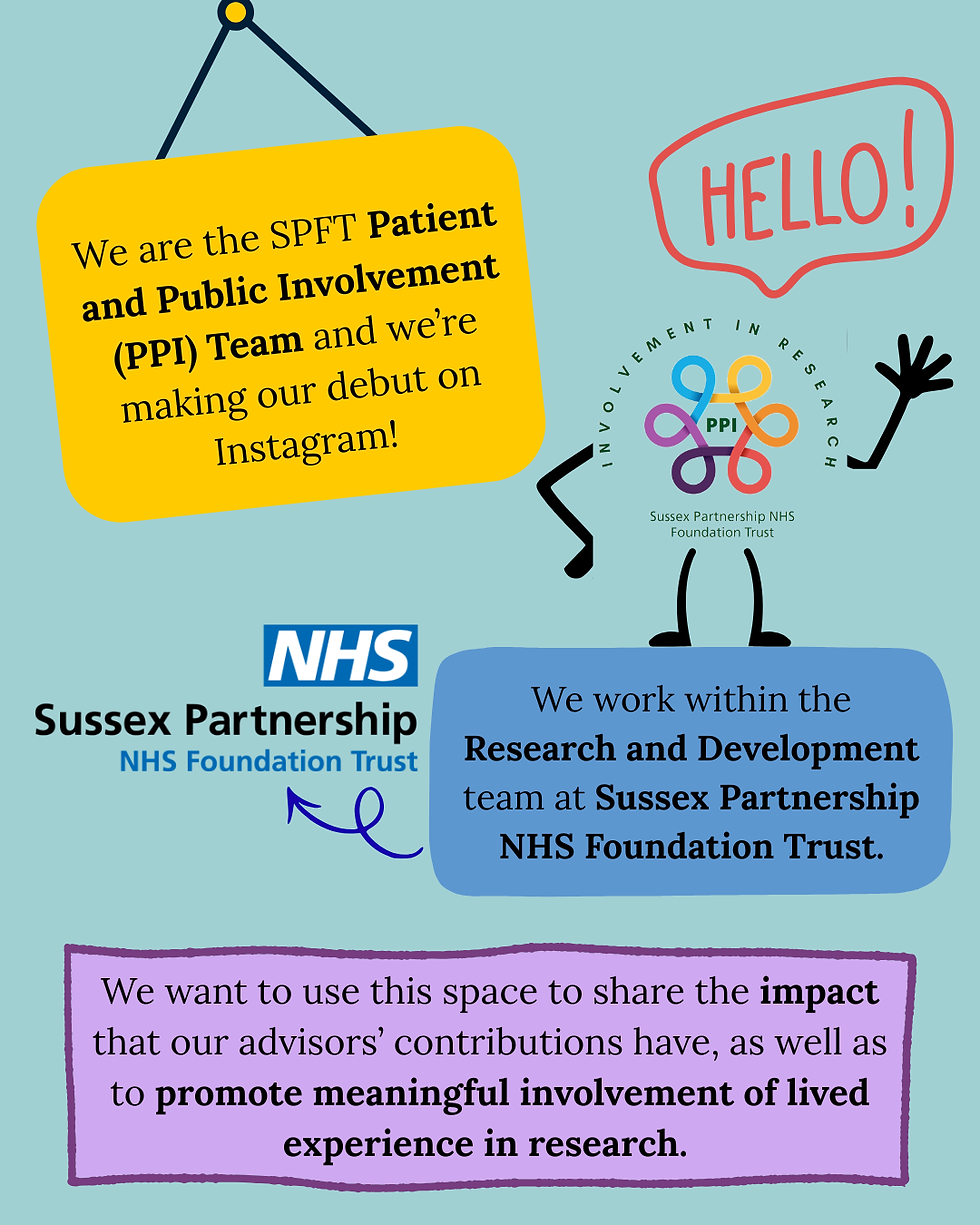
Patient and Public Involvement (PPI) is where research is carried out ‘with’ patients and the public, rather than ‘on’ or 'to' them. It seeks to improve research by involving people with their own mental health lived experience. Below is a post from our PPI Team's Instagram (@spft_involvement_in_research) explaining what PPI is.


What is the Youth PPI Café?
Quick read summary
The Café is an entirely youth lead space that seeks to improve research, by involving people with their own mental health lived experience. We do this by connecting young people (like yourself!) with researchers who are looking at relevant topics. These topics will always involve the mental health of young people. These usually focus on specific mental health topics such as anxiety or obsessive-compulsive disorder (OCD), and look at this in the context of other topics such as GP accessibility or creating new treatments.
Lived experience doesn't have to be your own personal experience: perhaps you have a close friend or family member that has personal experience of mental health. You also don’t need to have experience of the specific topic of the café to be able to attend (although for some sessions researchers ask that we prioritise people that do, for example, if the study is specifically about anxiety, we will prioritise those with relevant lived experience).
We have created the Youth PPI Café to give young people a space to have a real input within current mental health research that affects them. With the involvement of people with lived experience, research is more relevant, participants have a better research experience, and research is more likely to have impact on real services. Sussex Partnership Foundation Trust is one of the most research-active Mental Health Trusts in England. It has an award-winning Research Department, which supports the delivery of research studies that have implications for practice nationally and internationally. PPI is embedded within all its strands of research in the Trust.
We have two different groups, one for 11-15-year-olds and one for 16-25-year-olds. We have split these groups up so that we can make sure everyone gets the support that they need to be meaningfully involved in research. There are some differences in payment and safeguarding for our 11-15 group- you can read about both groups using the buttons below.
Each Youth Café session focuses on different studies of interest we would like to discuss as a group. In the past we have explored topics such as the psychological impact of COVID-19 on young people, using VR technology to combat school phobia, the comorbidity of anxiety and hypermobility, and ways to improve the CAMHS discharge process. The sessions involve anything from discussing the research question, brainstorming how to improve recruitment, looking at resources used in the study and thinking about the wording of questions/handouts. You will be given the opportunity to share your opinions and make your own individual contributions to different research studies that are centred around young people. We will feed back any constructive comments and views to researchers, to help positively shape the way their studies are carried out.
All key decisions are informed by our members, as we feel that this is the best way to create a blossoming, engaged community of young people interested in mental health research. We also try to make sure the topics we cover are of interest to our young members. We have meetings where we discuss research topics that young people would be particularly interested in seeing, and those that they would not be interested in; this helps us to decide which research is discussed at the Cafés. This project is continuously in development, with constant collaboration with young people.
Individuality is also central to our core values. Embracing the belief that young people are not all the same not only helps to maintain meaningful involvement but also enriches the research itself. The social contexts in which different young people exist, as well as the many pressures they face, are unique and can have a significant impact on their experience as a service users, and their ability to engage with services and research. As such, we feel it is vital to treat everyone as an individual.
Why do we call it a café? This is a question that we often get asked! It is important to make it clear that the Youth PPI Café is not a physical café; that is, a venue where young people go to get together over a snack or drink. However, it is based upon the premise of a café: an informal setting, where people can meet up over a coffee and have a general discussion about a particular topic. This 'café approach' has been extended to our online group and has been particularly helpful in ensuring that our members feel comfortable during sessions. At the moment, all future sessions are planned to be online, but we do sometimes have in-person events that you can attend to meet other advisors and celebrate your work.
What is it not?
The purpose of this group is not to offer therapeutic support. It is simply a chance to work alongside your peers, become involved in research and offer your unique perspective across a range of areas that impact young people. However, if you do find yourself in need of some extra support, or find any of the discussions particularly upsetting, we are able to signpost you to services which may be able to provide further support. Our Youth Café Coordinator will stay online for 15 minutes after each session, so you can chat to them if you would like. You can also email them with any non-urgent enquiries which they can help you with (within their working hours).
Meet the team
In our team, we have a Patient and Public Involvement (PPI) Coordinator that organises the sessions and can answer any questions that you may have about the Café. We also have some research assistants and placement students who work with us in the sessions to make sure that your voice is heard. They do this through ensuring that any comments in the chat box are read out in the session and take the minutes so that our feedback is recorded for the researcher to act upon. If you're a member of our 16-25 café and are interested in helping out with our 11-15y/o group, let us know!
Libby Warman (she/her)
Youth PPI (Patient and Public Involvement) Coordinator
Hi there 👋🏼 I’m Libby. I am the Youth PPI Café coordinator, which means I oversee and organise all Youth PPI Café related activities. As a young person with my own lived experience of mental health, I know just how important feeling heard and represented is, especially within research that actively affects us. I am passionate about the meaningful and effective involvement of young people in research which is what the Youth Café strives to accomplish. In my spare time, I enjoy reading, going to gigs and hiking!

Joshua Moses (he/him)
Co-facilitator
Hi, I'm Josh, the newest placement student with the PPI team (and I study psychology with neuroscience at university). I help to co-facilitate the Youth Café sessions and post on our social media. Outside of academics I love to read and play games and am always looking for recommendations. I'm also a music fanatic that loves playing instruments like piano and violin and working on musical production in many genres!"

Sam Robertson (she/her)
Lead for Service User and Carer Involvement and Youth Café Safeguarding Lead
Hi, I'm Sam, and I'm the Youth Café Safeguarding Lead. You can contact me at sam.robertson6@nhs.net. Outside of work, I love sport, crime novels and spending time with my beautiful dog Stella.

Being a Youth Café advisor
Quick read summary
Sessions are held remotely on Microsoft Teams and last an hour and a half. You will be paid (£15 Love2Shop voucher for 11-15s/£18.66 per hour for 16-25s) for your contributions, and will earn the title of ‘Research Advisor’ which you can put on your CV.
You can find out how to join the Café using the button below.
Benefits of joining
-
You will earn the title of “Research Advisor”
-
This title can be used on UCAS forms for university, or on your CV to demonstrate your role working with us and your contributions in this group.
-
You can also use Libby, the group coordinator, as a reference for applications.
-
-
You will be paid for your time (£15 Love2Shop voucher per session for 11-15s/£18.66 per hour for 16-25s)
-
Please note that this role should not be relied upon as a significant source of income – in order to carry out meaningful and effective involvement, we have a limited number of spaces on each session, so we cannot always promise you will be given a place. For 16-25 members- a percentage of your payment will automatically go into an NHS pension- if you would like to opt out of this let us know and we can help you do this. If you have any concerns about how involvement may impact any benefits you are receiving, get in touch and we’d be happy to help.
-
-
Find out about other involvement opportunities
-
We advertise other paid opportunities from other organisations/researchers, giving you access to other youth-led projects that align with our values.
-
-
Gain transferable skills
-
Get involved in creating content for our blog, social media, and newsletter
-
Develop your communication skills, and demonstrate your ability to present ideas in front of a group of peers and professionals
-
Learn directly from professionals in our training sessions- we hold careers sessions with various professionals with research and mental health (such as Clinical Psychologists, Research Assistants, Assistant Psychologists and Clinical Research Coordinators). We also are looking to hold developmental training sessions, such as a CV masterclass, applying for further education, and applying for research grants. If you have any suggestions for anything you want to see, get in touch or mention it in our next meeting!
-
-
Networking with our community
-
There's over fifty 11–25-year-olds with lived experience in our network! You can work with peers, get to know other young people in Sussex, and make some new friends.
-
You can also network with researchers from universities and other organisations, and several of our members have used these connections to secure further research work.
-
-
Directly see the impact of your work
-
As part of the ‘researcher agreement’ formulated by the group (see next section) researchers must provide feedback to the YP on what they are going to do or have done after coming to the cafe. This way, we can see the real impact of your involvement on the research study.
-
Our "Researcher Agreement"
We held the first session of the Youth PPI Café in May 2020, during which we put together a ‘Group Agreement’. Advisors and researchers must agree to these terms before they work with the café. This has since been updated, and will continue to be reviewed - if you have anything you would like to add or change please get in contact or mention it in the next meeting.
The key points from this agreement are detailed below:
-
Be receptive to everyone’s past experiences, and level of knowledge in this area
Work collaboratively and play to people's individual knowledge and abilities as we all come from different areas with different backgrounds and from different organisations
2. Shared experiences and opinions will be confidential
Confidentiality will only be breached if the facilitators deem it to be absolutely necessary, and in the young person’s best interest. This typically refers to times when facilitators feel that there is risk to either yourself, or others. You will always be told if we need to break confidentiality.
3. Have respect for others in the group
Be kind, listen to others, and respect other people’s opinions. Make this a safe space rooted in understanding and mutual respect.
4. Include everyone in discussions around the logistics of these meetings, and the way they are carried out
Allow everyone including YP to have a say on when meetings are so that it can work around people's lives
5. Be open to exploring new and alternative ways of thinking
Explore alternative pathways and think about unique ways of going about things to increase youth engagement
6. All contributions are equally valuable, regardless of how it is communicated
Including, and not exclusive to, written or verbal feedback, or feedback shared outside of the café session
Youth Café Sessions
The Youth Café can provide written feedback to researchers (over email) or face-to-face feedback through our online Teams sessions. These sessions happen approximately once a month and are usually on a Wednesday evening. This is the usual structure of our virtual meetings:
Time | Action |
|---|---|
Fri., June 20 | The Academy, L.A |
Thu., June 19 | Bamboo, Santa Barbara |
Sat., June 28 | Cheers, Santa Cruz |
Wed., July 6 | The Roxy, San Francisco |
6pm
6:10pm
6:15pm
7:15pm
7:15-7:30pm
Introduction (say hi, questions and updates)
Comfort break- get a drink, go to the loo
Researcher joins- introduction and discussion
End of session
Facilitator stays online so you can ask questions/chat if needed
We also just wanted to outline some general housekeeping for the groups. We ask that you read through these points and keep them in mind when coming along to a session:
-
All of our groups are held virtually via Microsoft Teams. If at any point you don’t want to have your video or audio on, that is absolutely fine. You can switch them off at the bottom of the screen. If you don’t want to attend a meeting but still want to be involved, we can usually arrange for you to give some feedback over email instead.
-
If you would prefer to use a pseudonym, rather than display your real name, that is also OK. But please do let the team know before the session, so we can keep a record of attendance.
-
Similarly, if anything becomes especially upsetting for you, and you want to leave, that is also OK. However, we do ask that you just drop a private message in the chat to one of the facilitators, just to let us know that you will be leaving. We can then make sure that you’re ok.
-
Please feel free to use the chat box at any point, if you would prefer to contribute this way rather than verbally. We will always have someone monitoring the chat in these sessions and will read this out loud to the group. If you think of something you'd like to add after the session, feel free to email the coordinator and they will pass it on to the researcher.
-
If you are accidentally ‘kicked out’ of the group, or lose connection, just click on the meeting link again and come back in. If you have any problems getting back in, just send us an email, and hopefully we’ll be able to help you out.
-
Finally, if you can be somewhere that is private and free from distractions, that would be ideal. No problem if that’s not possible – we know things can be a bit chaotic sometimes! If possible, join with headphones on so that the groups’ conversations are kept private and everyone feels comfortable to share.
If you have any questions about anything on this page, please feel free to email libby.warman1@nhs.net. Thank you for reading!